.png)
Reiki Isn't Just “Woo” Anymore - So Why Are People Taking It Seriously?
Once the kind of practice many people might have quietly dismissed as a little too “out there”, Reiki seems to be finding its way into a much broader conversation about wellbeing. So what changed?

Not that long ago, telling someone you were going for a Reiki session might have been met with a raised eyebrow.
Energy healing. Chakras. A practitioner placing their hands over your body without necessarily touching you. If you weren’t already familiar with the spiritual or holistic wellness world, it could all sound a little… woo.
And for plenty of people, it probably still does.
But something interesting seems to be happening. Practices that once sat firmly on the fringes of mainstream wellbeing are becoming increasingly visible. You hear people casually mention their Reiki practitioner alongside their Pilates class or massage. Energy work appears on retreat schedules. Conversations about intuition, nervous-system regulation, meditation, breathwork and spirituality have found their way into everyday life.
Reiki hasn’t necessarily changed.
Perhaps we have.
So, what actually is Reiki?
Reiki is a Japanese energy-healing practice that developed in the early 20th century. At the centre of the practice is the idea that there is a form of life-force energy flowing through us, and that a Reiki practitioner can work with this energy to support balance and wellbeing.
A typical session is surprisingly simple.
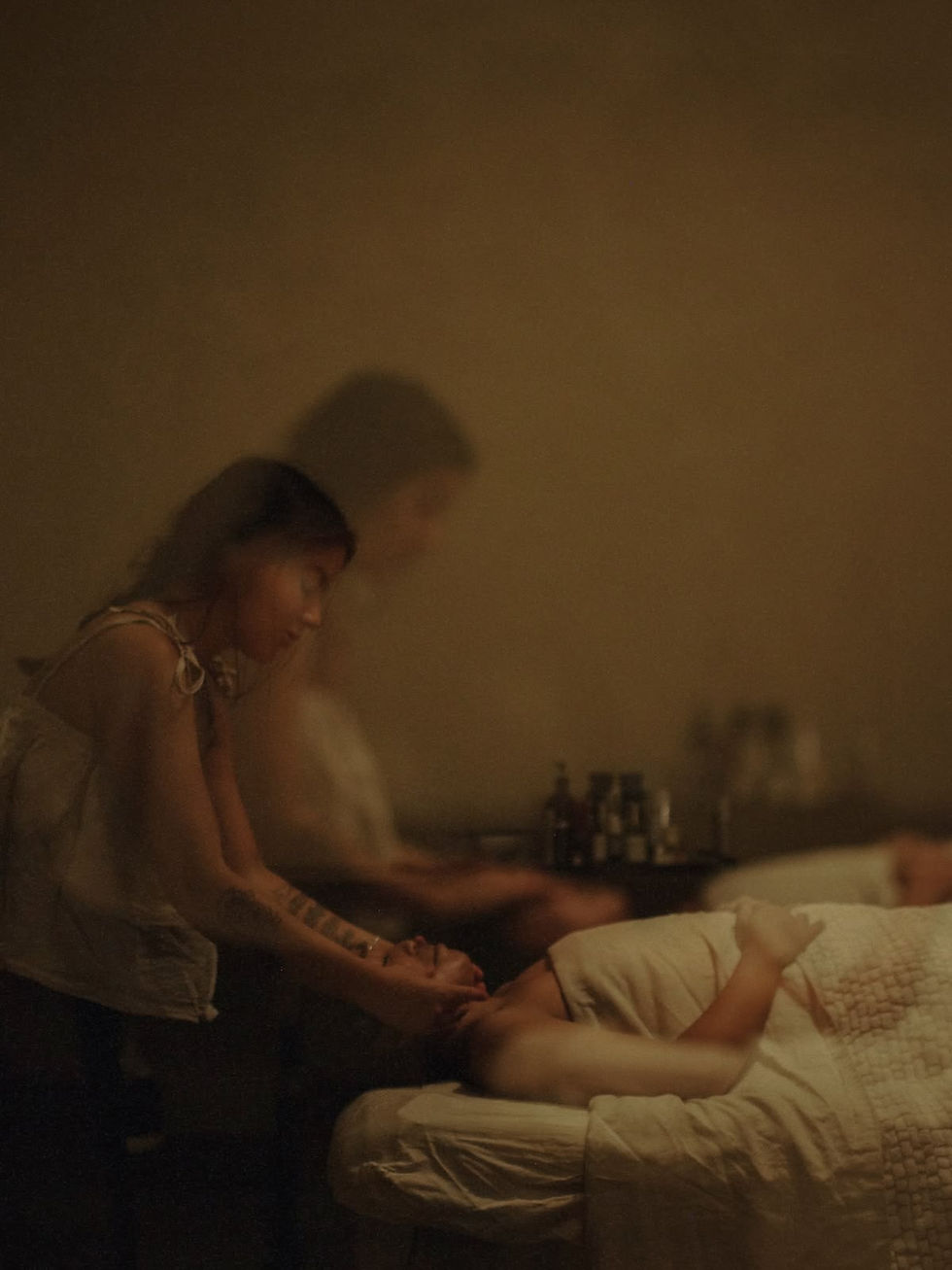
You remain fully clothed, usually lying on a treatment table while the practitioner moves through a series of hand positions, either gently touching the body or holding their hands slightly above it. There’s no massage or physical manipulation involved. Depending on the practitioner and space, there might be soft music, low lighting, essential oils or other elements used to create a calming environment.
And then, essentially, you lie there.
Some people describe warmth or tingling. Others say they feel heavy, light, emotional or deeply relaxed. Some report vivid imagery or a sense of energy moving through the body. And some people don't notice very much at all.
There isn't one experience you're supposed to have.
So why the shift?
Perhaps part of Reiki's growing appeal has less to do with Reiki itself and more to do with the way our relationship with wellbeing is changing.
For a long time, wellness was largely spoken about through the physical: how we eat, how often we exercise, how much sleep we get.
Those things still matter, of course. But our conversations have widened.
We're talking more about stress. Burnout. Boundaries. Regulation. Connection. Meaning. The way our environments make us feel. The things we carry emotionally. Whether we're actually present in our lives.
And somewhere within that broader conversation, there seems to be more room for practices that don't fit neatly into one category.
For some people, Reiki is deeply spiritual. For others, it's simply an hour in which they can be still and receive rather than do. Someone else might be fascinated by the energetic philosophy without being completely convinced by it.
You don't necessarily have to approach it in the same way.

Maybe we’re becoming more comfortable with not knowing
There can be a tendency to think we need to choose a side with practices like Reiki.
Either you believe in energy healing completely, or you dismiss the whole thing.
But there is a fairly large space between those two positions.
You can wonder whether there's something to the energetic side of Reiki while also recognising that its proposed energy field hasn't been scientifically established. Research into Reiki and specific health outcomes is still limited and mixed, and it shouldn't be treated as a replacement for medical or mental-health care.
And you can know all of that while still being curious about the experience.
Because perhaps not every question has to begin with “Can I prove this?”
Sometimes it can begin with:
What is this? Why have people practised it for so long? What do people experience when they try it? And what might I notice if I experienced it for myself?
That doesn't require blind belief.
It requires curiosity.
There’s also something incredibly simple about it
Strip away the language of energy for a moment and consider what a Reiki session asks of you.
For perhaps 45 minutes or an hour, there is nowhere else you need to be.
You're not scrolling. You're not working. You're not talking your way through a problem. You're not trying to improve your performance or achieve something.
You're lying still, in a quiet room, while somebody holds space for you.
In a culture where we're constantly consuming, responding, moving and thinking, maybe there's something compelling about an experience that asks almost nothing from us.
That doesn't explain everything people report experiencing during Reiki. Nor does it prove the energetic philosophy behind the practice.
But it may be part of why people leave feeling like something has shifted.
Taking something seriously doesn’t mean believing everything about it
Maybe this is the more interesting change happening within wellness.
Taking Reiki seriously doesn't have to mean deciding that every claim made about energy healing is true.
It can mean being willing to understand something before dismissing it.
It can mean listening to the people who practice it, while still asking questions.
It can mean recognising the difference between someone's personal experience and a scientific claim.
And it can mean allowing ourselves to explore something simply because we're curious about how it might feel.
There are many practices within wellbeing that exist somewhere between the measurable, the experiential and the spiritual. Reiki is just one of them.
Perhaps our relationship with those practices doesn't need to be quite so black and white.
You don’t have to believe in Reiki to explore it
At Sondera, we're not particularly interested in telling you what you should believe.
We're much more interested in what happens when we get curious about the things we don't completely understand.
Meet the people who practice them. Ask the questions that might feel silly. Understand where these practices come from. Experience them where we can. Look at what we know, acknowledge what we don't, and then let you decide what resonates.
Reiki might become something you return to again and again.
You might try it once and decide it isn't for you.
Or you might simply understand something you previously dismissed a little better.
All three are perfectly valid places to land.
You don't have to believe everything. You don't have to dismiss everything either. Sometimes, you can just start with curiosity.